


Best Creatine: How to Choose When There Is No Official Test Winner
Searching for the best creatine usually ends the same way: ten ranking lists, ten different winners. That is no accident. In Germany, as far as we could find (as of November 2026), neither Stiftung Warentest nor Öko-Test has published a product test that crowns a creatine powder. Check directly with the institutes if you want to be sure.
So “test winner” titles mostly come from comparison sites with their own scoring systems. That can be useful, but it is not an independent lab test. This page therefore does not add another ranking. It gives you the checklist behind it: how to spot the best creatine, what studies and consumer advocates say, and what women can look for when choosing.
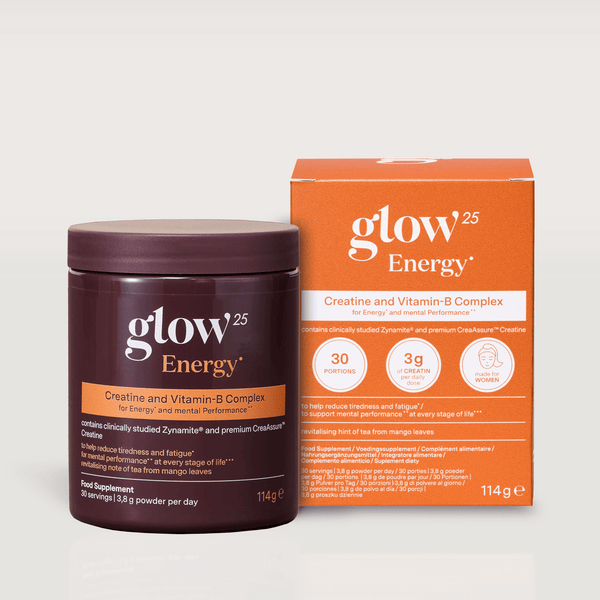
To be upfront: we also introduce our own powder, Glow25 Energy. We do not call it a “test winner”. We show how it fits the checklist, and you decide.
Best creatine at a glance
- No official winner: titles come from sites with their own criteria.
- Form: monohydrate is the benchmark; other forms are not shown to be better.
- Dose: 3 g of creatine equal 3.41 g of monohydrate. Look for “of which creatine”.
- Proof: independent lab reports and the Cologne List seal count for more than a title.
- Women: the same criteria apply; a women’s label does not replace them.
🌟 Choose your Glow25® Energy pack
Creatine powder with mango leaf extract and five B vitamins – caffeine-free, vegan and with a green tea taste.
The more cans, the lower the price per can. One can lasts 30 days.
1 can · 30 days
 9%save
€31.99/can
Regular price: €34.99
Total: €31.99
Save €3.00Add to cart · 9% off →- Free shipping over €29 (DE + AT)
- 60-day money-back guarantee
★ Most popular
3 cans · 90 days
25%save
€26.25/can
Regular price: €104.97
Total: €78.75
Save €26.22Add to cart · 25% off →- Free shipping over €29 (DE + AT)
- 60-day money-back guarantee
2 cans · 60 days
14%save
€29.99/can
Regular price: €69.98
Total: €59.98
Save €10.00Add to cart · 14% off →- Free shipping over €29 (DE + AT)
- 60-day money-back guarantee
Food supplements are not a substitute for a balanced and varied diet and a healthy lifestyle. Do not exceed the recommended daily intake. Keep out of the reach of young children. Not suitable for children, adolescents, pregnant or breastfeeding women. Prices include VAT, plus shipping. The discount is applied automatically in your cart via the button.
What’s in this article
- Best creatine: who awards the “test winner” title?
- Creatine test at home: six criteria
- Why monohydrate stays the benchmark
- Price per day: what good creatine costs
- Best creatine for women: what to look for
- Myth check: water, kidneys, hair, loading
- Where Glow25 Energy fits the checklist
- Creatine in everyday life
- FAQ
- Sources
Best creatine: who awards the “test winner” title, and by which rules?
A test winner should come from transparent rules: the same checks for every product, open criteria, independent evaluation. For creatine powders that is rare. Many comparison sites use affiliate links and their own scoring. That is not automatically wrong, but it is different from a test by an independent consumer organisation.
What does exist is an official sample. In 2019, the state laboratory for consumer protection in Saxony-Anhalt, Germany, analysed 11 creatine products from retail. The declared creatine contents were confirmed. Daily doses were between 2.6 and 5.1 g of creatine for products without a performance claim, and between 2.6 and 4.5 g for products with the strength-training claim.2 It is a small, regional sample from 2019, but the lesson holds: do not rely on a title, rely on information you can check yourself.
Independent lab testing also exists internationally, mostly behind a paywall. In June 2026, the US organisation ConsumerLab published tests of twelve creatine products. Most met quality standards; one failed because it contained too much creatinine, a sign that the creatine had degraded. The test also showed that a higher price did not mean higher quality: 5 g of monohydrate cost between $0.13 and $1.85.6
Be careful with unknown sellers: the German consumer advice centre warns that products from unknown online sellers abroad can contain heavy metals, unapproved creatine compounds or fillers. In some cases only about a third of the declared creatine monohydrate was in the product.1
Creatine test at home: six criteria for the best creatine
With these six questions you can check any creatine powder yourself, no lab needed.
-
Which form?
Creatine monohydrate is the best-researched form. Other forms need good evidence, not just a new name.
-
How much creatine?
What counts is pure creatine per serving. 3 g of creatine equal 3.41 g of monohydrate.1 Look for “of which creatine”.
-
What else is inside?
Pure creatine needs a single ingredient. Extra ingredients are fine if they have a purpose and are clearly listed.
-
What proof?
According to the consumer advice centre, the Cologne List seal stands for a minimised doping risk. Independent lab analyses reduce the risk further.1
-
Does the scoop fit?
Weigh the scoop once. Does its fill match the stated serving? It is worth checking.
-
What does a day cost?
Compare the price per day with 3 g of creatine, not the price of the tub. The calculator below helps.
A note on brand names: Creapure® is a branded raw material based on creatine monohydrate, not a separate form of creatine. A raw material name tells you something about the ingredient, not automatically about the finished product. That is why proof for the final product matters.
Best creatine form: why monohydrate stays the benchmark
In its 2017 position stand, the International Society of Sports Nutrition describes creatine monohydrate as one of the most effective forms for athletic performance. For healthy adults, the authors found no evidence of harm, including with long-term use in studies.3
Newer forms often promise better solubility or tolerance. One example is buffered creatine (Kre-Alkalyn). In a controlled trial with 36 resistance-trained participants, it did not lead to greater changes in muscle creatine, body composition or strength than monohydrate over 28 days. It also did not show fewer side effects.4 The study was funded by the company AlzChem, which is a reason to read it with care. Its result matches the consumer advice centre’s assessment, though: other compounds such as creatine HCl, malate or esters are not more effective, in some cases less effective, usually more expensive and less well supported.1
Two compounds, creatine malate and creatine alpha-ketoglutarate, count as novel foods according to the consumer advice centre and are not approved in the EU so far.1
Price per day: what the best creatine really costs
Tub prices are misleading. A big 500 g tub looks cheap, a small one with extras looks expensive. You can only compare once you calculate the daily serving. The calculator assumes 3 g of creatine per day, which equals 3.41 g of monohydrate.1
Work out your price per day
Example: €19.99 for 500 g of pure monohydrate works out at about €0.14 per day.
You find the share of monohydrate in the ingredient list (for example “89%”). For pure monohydrate it is 100%.Powders with extras such as vitamins or plant extracts cost more per day. That is not a flaw, it is a question of purpose: if you only want creatine, pure monohydrate is cheaper. If you want an everyday formula, count the other ingredients too.
Best creatine for women: what to look for
There is no official “best creatine for women” seal. That is not bad news: according to the German consumer advice centre, creatine does not work differently in women and men.1 The same six criteria apply. A pink tub does not change the chemistry.
Women still deserve a closer look. A 2021 review describes that women have on average 70 to 80 percent lower endogenous creatine stores than men and also take in less creatine through food.5 People who eat little meat and fish also start with lower stores, according to the consumer advice centre.1 The authors also call the research on women patchy. They point to a large review that found no adverse effects on the digestive tract, kidneys, liver or cardiovascular system in women.5
What is proven and what is not? Two statements are authorised in the EU: on physical performance in explosive strength training and, for adults over 55, on the effect of strength training on muscle strength. Both apply from 3 g of creatine per day.1 For brain, mood or menopause there are first indications but no authorised claim. EFSA rejected a claim on cognitive function in 2024 because the data were not sufficient.1 Credible products promise nothing here.
Important: pregnant and breastfeeding women, people with pre-existing conditions (especially of the kidneys), children and adolescents should only take creatine on medical advice.1 For background, read Creatine Monohydrate: Benefits, Dosage & What Science Really Says and Menopause Symptoms: How to Tell What’s Hormonal and What’s Just Life.
Myth check: water, kidneys, hair, loading
MythCreatine makes you bloated
Weight can rise slightly at the start. According to the consumer advice centre, this is not body fat but water bound inside muscle cells.1
MythCreatine damages the kidneys
For healthy adults, the ISSN position stand found no evidence of this.3 Creatine can raise the creatinine value in blood. According to the consumer advice centre, this is not a problem and not a sign of impaired kidney function, but your doctor should know you take it. With kidney conditions, take it only on medical advice.1
MythCreatine causes hair loss
The idea goes back to a three-week study from 2009 that did not measure hair loss directly. According to the consumer advice centre, a twelve-week study in 2025 looked at the link directly and found that creatine does not cause hair loss.1
MythCreatine only works with a loading phase
According to the consumer advice centre, a loading phase is not necessary. It only fills the stores faster and can cause stomach and gut problems in some people.1 Taking it regularly every day is what counts. For recovery in general, see Muscle Soreness: What Is Really Going On – and What the Research Says About Recovery.
Where Glow25 Energy fits the checklist
Time for an honest cross-check. If you are weighing up the best creatine for your routine, here is how Glow25 Energy scores against the criteria, based on the product page:
| Criterion | Glow25 Energy | Our take |
|---|---|---|
| Form | Creatine monohydrate (CreaAssure™) | The best-researched form. CreaAssure™ is a branded raw material. |
| Dose | 3.8 g powder per serving, 89% creatine monohydrate | Find the “of which creatine” value in the nutrition table on the pack. |
| Ingredients | Plus 300 mg mango leaf extract (Zynamite®), five B vitamins, inulin | Not pure creatine, on purpose: Energy is an everyday formula. |
| Caffeine and sugar | No caffeine, no taurine, no sugar | For anyone who does not want a stimulant effect. |
| Tolerance | Vegan, gluten-free, lactose-free | Traces of egg and milk cannot be ruled out due to production. |
| Taste | Green tea with a fruity note | Stir into water or your favourite drink. |
| Price | €34.99 for 114 g (30 servings) | More per day than pure monohydrate. The offer above lowers the price per can. |

Who is Energy for?
You want creatine as a daily ritual, without caffeine and without the gym look. Glow25 says it developed Energy for the everyday life of women over 40. Vitamins B2, B3, B5, B6 and B12 contribute to normal energy-yielding metabolism and to the reduction of tiredness and fatigue.
Creatine increases physical performance in successive bursts of short-term, high-intensity exercise. The statement applies to adults and from 3 g of creatine per day.1
Who is it not for?
If you only want creatine at the lowest price, pure monohydrate with proof of quality is the better choice. Not suitable for children, adolescents, pregnant or breastfeeding women.
Save up to 25% on Energy nowCreatine in everyday life: how to make it a routine
Creatine works through filled stores, not through a single serving. According to the consumer advice centre, timing does not matter; daily regularity does.1 Link it to something you already do, such as breakfast.
With Glow25 Energy, you stir one level scoop (3.8 g) into 300 ml of water or your favourite drink, with or after a meal and not on an empty stomach. Creatine breaks down in liquid over time, especially in warm or acidic drinks, so drink it promptly and follow the intake recommendation on the pack.
Conclusion: the best creatine is the one whose claims you can check
As far as we could find, there is no official test winner for creatine. What is good is what you can verify: monohydrate, honest dose information, clear ingredients, proof of purity and a fair price per day. For women the same standards apply; a women’s label does not replace them.
If you want a caffeine-free everyday formula with creatine, mango leaf extract and B vitamins, Glow25 Energy fits. If you only want creatine, a pure monohydrate with proof of quality is a good choice.
Ready for your daily routine?
Choose your pack and save with more cans.
Go to the offer: save up to 25%Best creatine: frequently asked questions
Is there an official “best creatine” test winner?
As far as we could find (as of November 2026), neither Stiftung Warentest nor Öko-Test in Germany has crowned a creatine powder. “Test winner” and “best creatine” titles usually come from comparison sites with their own criteria. Independent lab tests exist, for example from ConsumerLab in the US, but full results sit behind a paywall.6
What is the best creatine?
What is the best creatine for women?
There is no official winner. According to the German consumer advice centre, creatine works the same way in women and men.1 The same checklist applies. A label saying “for women” says little; form, dose and added ingredients matter more.
Is creatine HCl or buffered creatine better than monohydrate?
Superiority has not been shown. In a controlled trial with 36 resistance-trained participants, buffered creatine did not lead to greater changes in muscle creatine, body composition or strength over 28 days.4 The consumer advice centre says other compounds are not more effective, and some are less effective.1
How much creatine is in one serving?
Creatine monohydrate is not 100% pure creatine. According to the German consumer advice centre, 3 g of creatine equal 3.41 g of monohydrate.1 Look for the line “of which creatine”, not just the monohydrate amount.
Is expensive creatine the best creatine?
Not necessarily. ConsumerLab found that 5 g of creatine cost between $0.13 and $1.85 across the products it tested, and a higher price did not mean higher quality. The best creatine is not automatically the priciest.6
Does creatine work for everyone?
No. The consumer advice centre mentions that 20 to 30 percent of people are so-called non-responders and cannot expect positive effects, probably because their stores are already well filled.1 Creatine also works alongside training; it is not a replacement for it.
Creatine powder or capsules?
What counts is how much creatine you actually take each day. Powder is flexible and often cheaper per gram. Capsules are handy on the go, but you may need several for one serving.
Who should not take creatine without medical advice?
People with pre-existing conditions, especially of the kidneys, pregnant and breastfeeding women, children and adolescents should only take creatine on medical advice.1 Glow25 Energy is not suitable for children, adolescents, pregnant or breastfeeding women.
How is Glow25 Energy different from plain creatine?
Besides monohydrate, Glow25 Energy contains mango leaf extract (Zynamite®), five B vitamins and inulin. It is caffeine-free and tastes of green tea with a fruity note. Plain monohydrate costs less per day; Energy is designed as an everyday formula.
Sources
- German consumer advice centre / Verbraucherzentrale (as of 15 April 2026): Kreatin: Wirkung, Risiken und was beim Kauf wichtig ist (in German).
- LAV Sachsen-Anhalt (2019): Schwerpunktaufgaben 2019: Gehalt an Kreatin in Nahrungsergänzungsmitteln und Sportlernahrung (in German).
- Kreider RB et al. (2017): International Society of Sports Nutrition position stand: safety and efficacy of creatine supplementation in exercise, sport, and medicine. J Int Soc Sports Nutr 14:18.
- Jagim AR et al. (2012): A buffered form of creatine does not promote greater changes in muscle creatine content, body composition, or training adaptations than creatine monohydrate. J Int Soc Sports Nutr 9:43.
- Smith-Ryan AE et al. (2021): Creatine Supplementation in Women’s Health: A Lifespan Perspective. Nutrients 13(3):877.
- ConsumerLab (22 June 2026): ConsumerLab Shows Which Creatine Is Best (press release).
Food supplements are not a substitute for a balanced and varied diet and a healthy lifestyle. This article does not replace medical advice. Research status: November 2026.
More about creatine and energy
 Glow25 MagazineCreatine Monohydrate: Benefits, Dosage & What Science Really SaysRead article →
 Glow25 MagazineMuscle Soreness: What Is Really Going On – and What the Research Says About RecoveryRead article →
 Glow25 MagazineVitamins for Tiredness: 9 Nutrients With an Authorised Claim – and What Studies SayRead article →
 Glow25 MagazineMenopause Symptoms: How to Tell What’s Hormonal and What’s Just LifeRead article →


