


Elastine vs. Collagen: What Do They Do in Your Skin?
Pinch your skin gently, let go – and it bounces back. That is elastine at work.
Elastine is the protein that lets tissue stretch and then return to shape. Collagen, on the other hand, provides firmness and structure. In the dermis, the middle layer of your skin, the two form one shared network. So elastine and collagen are not rivals – they are a well-rehearsed team.
In this guide you will learn how elastine and collagen differ, how they work together, and what research says about taking elastine as a supplement. We also take an honest look: where is the evidence for collagen broader, and where does elastine still have open questions?
Curious what a collagen routine can look like in everyday life? Go straight to Glow25 Collagen Plus.
See Collagen Plus →What you will find in this article
- What is elastine? The rubber band in your skin
- Collagen vs elastine: rope and spring
- How collagen and elastine work together
- What affects elastine – and what you can influence
- Elastine supplements? An honest look at the evidence
- Three elastine myths, fact-checked
- A simple collagen ritual
- Elastine and collagen: frequently asked questions
Fitting the topic: Glow25 Collagen Plus, with bovine collagen hydrolysate, vitamin C, zinc and biotin. Prices as of 8 Oct 2026.
Choose your Collagen Plus
Same formula, three ways to get it: buy once, or subscribe and save – whatever fits your routine.
One-time purchase
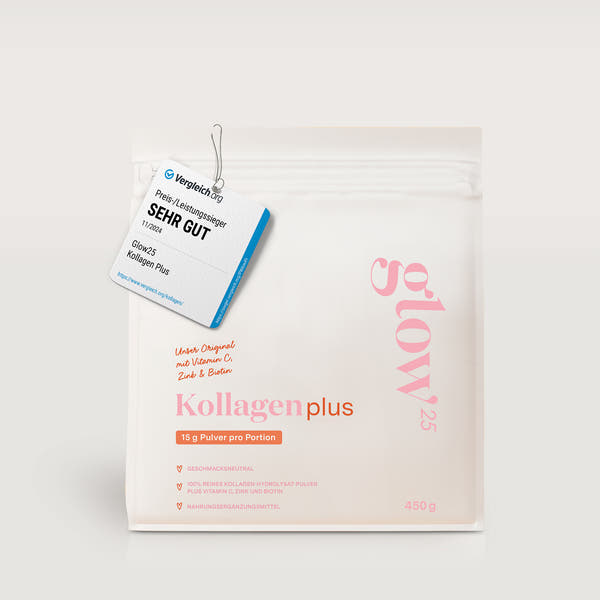
£39.99 / pack
One pack, no subscription. You decide each time.
View product →- Free shipping over £49
- 60-day money-back guarantee
Quarterly subscription
£29.99 / pack
was £39.99
Delivered every 3 months (min. 3 packs), pause whenever you need.
Save 25% · £10 per pack View product & choose subscription →- Free shipping with subscription
- 60-day money-back guarantee
Monthly subscription
£33.99 / pack
was £39.99
Delivered every month, pause whenever you need.
Save 15% View product →- Free shipping with subscription
- 60-day money-back guarantee
Prices incl. VAT, plus shipping (free over £49 or with a subscription). The button takes you to the product page, where you choose one-time purchase or subscription and add Collagen Plus to your cart. Food supplements are not a substitute for a balanced diet.
What is elastine? The rubber band in your skin
Elastine is a fibre protein. You find it wherever tissue has to stretch and recoil: in the lungs, in large blood vessels and in the skin. In the dermis, elastic fibres make up only about 2–4% of the fat-free dry weight, according to a review. That sounds small. It is still enough to make your skin spring back after every smile and every movement.
Elastine is made by fibroblasts, the connective-tissue cells. They first release tropoelastine – the soluble building block from which elastine forms. An enzyme then cross-links these blocks into stable elastic fibres.
What makes elastine special: it is produced mostly early in life. After that, very little new elastine is made, and the existing fibres last a very long time – their half-life is on the order of a human lifespan. That is a strength and a weakness at once: elastine is robust, but what is lost is hard to replace.
Collagen vs elastine: rope and spring
Collagen and elastine are often mentioned in the same breath, but they do different jobs. Pick a tab to look at each role on its own.
Collagen: the rope
Collagen is the scaffold. Its fibres are very resistant to pulling and give the dermis structure and firmness. It is the most abundant protein in skin and – unlike elastine – is continuously built up and broken down. Over the years the body makes less new collagen.
Elastine: the spring
Elastine is the rubber band. Its fibres stretch and then contract again. It makes up only a small share of the dermis, but it is the reason for skin’s recoil. Elastine is long-lived, yet hardly any new elastine is made in adulthood.
Collagen and elastine: the network
Together they form a network: collagen provides firmness, elastine provides flexibility. Skin keeps its shape and adapts to movement. Both proteins are made by fibroblasts – and both respond to UV radiation and lifestyle.
| Collagen | Elastine | |
|---|---|---|
| Job | Tensile strength, structure and firmness | Stretch and recoil |
| Image | Rope or scaffold | Spring or rubber band |
| Share of the dermis | Most abundant protein in skin | Around 2–4% of fat-free dry weight |
| Renewal | Continuously built up and broken down; new production declines over the years | Made mostly early in life, little new elastine in adulthood |
| Durability | Fibres are regularly remodelled | Very long-lived, half-life on the order of a lifespan |
| Evidence on supplements | Many studies on collagen hydrolysate | Evidence on taking elastine is lacking according to AOK; focus is on UV protection |
How collagen and elastine work together
Picture a trampoline: the firm mat carries your weight, the springs bring you back. In skin, collagen plays the mat and elastine plays the springs. Both fibre types are produced by the same cells, the fibroblasts, and are woven together in the dermis. If one part fails, the teamwork suffers.
The sun shows how sensitive this network is to long-term stress. With chronic UV exposure the dermis changes: the collagen-rich upper layer is partly replaced by disorganised clumps of elastine material – experts call this solar elastosis. The normal mesh of fine elastic fibres is lost in the process.
So an interesting question is whether collagen can influence elastine too. One study in 114 women looked at exactly this with a specific collagen peptide – more on that in the supplement section below. If you are curious about the other collagen types, read Type 2 Collagen – Benefits, Uses and Sources.
What affects elastine – and what you can influence
The honest news first: over the years less elastine is made, and that is a perfectly natural part of life. At Glow25 the goal is not to fight ageing – it is to take good care of what your body brings.
According to the AOK health magazine, these factors influence elastine in the skin:
- Time: The body makes less and less elastine over the years. Elastine that is lost is not replaced.
- UV radiation: It is considered a major factor in the destruction of elastine.
- Smoking and pollution: Both can attack elastine further.
- Diet and lifestyle: A balanced, vitamin-rich diet and exercise are among the things you can influence yourself.
The good news: some of this is in your hands. If you like, protect your skin with sunscreen in strong sun – according to AOK one of the most important levers. Dermatology experts also describe sunscreen and antioxidants as ways to protect existing elastine rather than hoping to replace it.
Elastine supplements? An honest look at the evidence
Online you will meet powders, capsules and drinking ampoules marketed with elastine. The question is: what does research know? A sober look at three sources helps.
Meta-analysis · 26 trials
Effects of Oral Collagen for Skin Anti-Aging (Pu et al., Nutrients 2023)
The analysis of 26 randomised trials with 1,721 participants in total found better values for skin hydration and elasticity with collagen hydrolysate than with placebo. The authors point to risks of bias in the individual trials and call for larger studies.
Read the study →Placebo-controlled trial · 114 women
Bioactive Collagen Peptides and Dermal Matrix (Proksch et al., Skin Pharmacol Physiol 2014)
114 women took 2.5 g of a specific collagen peptide or placebo daily for eight weeks. In skin fluid from a subgroup, procollagen type I was 65% higher and elastine 18% higher than in the placebo group. The authors stress that the results apply only to this collagen peptide. The test product was provided by its manufacturer.
Read the study →Review · elastine in skin
Clinical Relevance of Elastine in the Structure and Function of Skin (Baumann et al., 2021)
The review describes that elastine turns over very slowly, that less is produced after maturity, and that there is no established treatment that increases elastine production. Current strategies aim to protect existing elastine. Note: the paper was funded by a manufacturer of aesthetic products.
Read the study →Our takeaway from the evidence: For elastine as a supplement, solid evidence is lacking – the expert-reviewed AOK health magazine says the same. For collagen hydrolysate the data is much broader. What matters: the elastine results from the Proksch study apply to the specific collagen peptide tested and cannot automatically be transferred to other products.
Three elastine myths, fact-checked
There is a lot of half-knowledge around elastine. Click through the three most common claims.
Myth“Elastine from a cream or powder refills your elastic fibres.”
Fact check: There is no solid evidence for this so far. The AOK health magazine states that scientific evidence is lacking that such products noticeably slow skin ageing, and the Baumann review sees only limited evidence that active ingredients in creams reach deeper skin layers. Lost elastine can hardly be restored.
Myth“The sun only harms collagen.”
Fact check: UV radiation damages elastine too. It is considered a major factor in the breakdown of elastic fibres, and chronic sun exposure can even lead to solar elastosis. Sun protection is worth it for the whole collagen–elastine network.
Myth“Collagen and elastine are basically the same thing.”
Fact check: Both are structural proteins of the dermis, but with different jobs: collagen provides firmness, elastine provides recoil. They also differ in turnover – collagen is renewed continuously, elastine hardly at all.
A simple collagen ritual
If you would like to bring collagen into your day, you do not need a complicated programme. With Glow25 Collagen Plus you stir in one serving daily – 15 g, equal to one level scoop – into water, juice, a smoothie or coffee. For hot drinks: keep it below 80 °C, because vitamin C is heat-sensitive.
On the ingredients: vitamin C contributes to normal collagen formation for the normal function of the skin. Zinc helps maintain normal skin, and biotin helps maintain normal skin and hair. Important, and honestly said: Collagen Plus does not contain elastine. It is a collagen product – as part of a balanced diet and a lifestyle that feels good to you.
To find out which of our collagen products suits your day, read An overview of Glow25 collagen products: Which one is right for you?. And if you want to know exactly what goes into a good powder, Collagen Ingredients: What's Really Inside Good Collagen Powder like Glow25 has the details.
Elastine and collagen: frequently asked questions
What does elastine do for skin?
In the dermis, elastine provides stretch and recoil. Thanks to elastic fibres, skin returns to its original shape after being stretched. Elastine is also found in the lungs and blood vessels.
What is the difference between collagen and elastine?
Collagen gives firmness and structure, elastine gives flexibility and recoil. Collagen is the most abundant protein in skin and is renewed continuously. Elastine makes up only about 2–4% of the dermis’ fat-free dry weight and is hardly produced in adulthood.
Is it possible to get back lost elastine?
According to a 2021 review, there is no established treatment that increases elastine production in skin. The body makes elastine mostly early in life. The sensible approach is therefore to protect existing elastine – for example from UV radiation and smoking.
Which is more important for skin, collagen or elastine?
Neither can do the job alone. Collagen provides the framework, elastine the flexibility. They work as a team, which is why caring for the whole network matters more than playing one against the other.
Do collagen supplements help elastine too?
In a placebo-controlled study with a specific collagen peptide, a higher elastine content was measured in skin fluid after eight weeks. The authors stress that this applies only to that peptide. A general promise cannot be derived from it.
What damages elastine in skin?
Best documented are UV radiation, smoking and pollution, plus the natural passage of time. Sun protection and a healthy lifestyle are among the things you can influence yourself.
Does Glow25 Collagen Plus contain elastine?
No. Glow25 Collagen Plus contains 99.8% bovine collagen hydrolysate plus vitamin C, zinc and biotin. Vitamin C contributes to normal collagen formation for the normal function of the skin.
Elastine and collagen: a team you can support
Elastine gives your skin recoil, collagen gives it firmness. Lost elastine is hard to replace – all the more reason to treat the whole network well. If you like, start with collagen as a small daily ritual.
Discover Collagen Plus →Learn more
Keep reading with more articles from the magazine.

Sources
- Pu S-Y et al.: Effects of Oral Collagen for Skin Anti-Aging: A Systematic Review and Meta-Analysis. Nutrients 2023;15(9):2080. doi.org/10.3390/nu15092080
- Proksch E et al.: Oral Intake of Specific Bioactive Collagen Peptides Reduces Skin Wrinkles and Increases Dermal Matrix Synthesis. Skin Pharmacol Physiol 2014;27(3):113–119. doi.org/10.1159/000355523
- Baumann L et al.: Clinical Relevance of Elastin in the Structure and Function of Skin. Aesthet Surg J Open Forum 2021;3(3):ojab019. doi.org/10.1093/asjof/ojab019
- AOK health magazine (German): Elastin – ein Protein, das für die Hautelastizität sorgt (11 June 2025). aok.de
This article is for general information and does not replace medical advice. Food supplements are not a substitute for a balanced and varied diet and a healthy lifestyle. Do not exceed the stated recommended daily intake.


